

Foot-Candle Requirements by Area
Foot-candle requirements by area are best used as design targets, not blind rules. They help you set a realistic starting point for lighting layout, fixture spacing, and photometric planning. But the right number still depends on the task, the surface, the uniformity goal, the user group, and the local project requirements.
That is why the most useful question is not only “How many foot-candles?” It is also “Where are those foot-candles measured, how even are they, and what does the space need to do?”
This guide covers practical starting ranges for parking lots, warehouses, offices, classrooms, and sports facilities.
How to use foot-candle targets correctly
A foot-candle measures how much light reaches a surface. In the United States, it is one of the most practical ways to review illumination levels on a work plane, floor, site surface, or field.
- set early design expectations
- compare fixture spacing options
- decide whether a space may be overlit or underlit
- prepare for a photometric plan
Do not use them as the only design criterion. Uniformity, glare control, spill light, and task visibility matter too.
One foot-candle is about 10.76 lux.
Practical foot-candle ranges by area
These ranges are useful planning references for common project types. They are not substitutes for owner criteria, IES guidance, league requirements, or local code review.
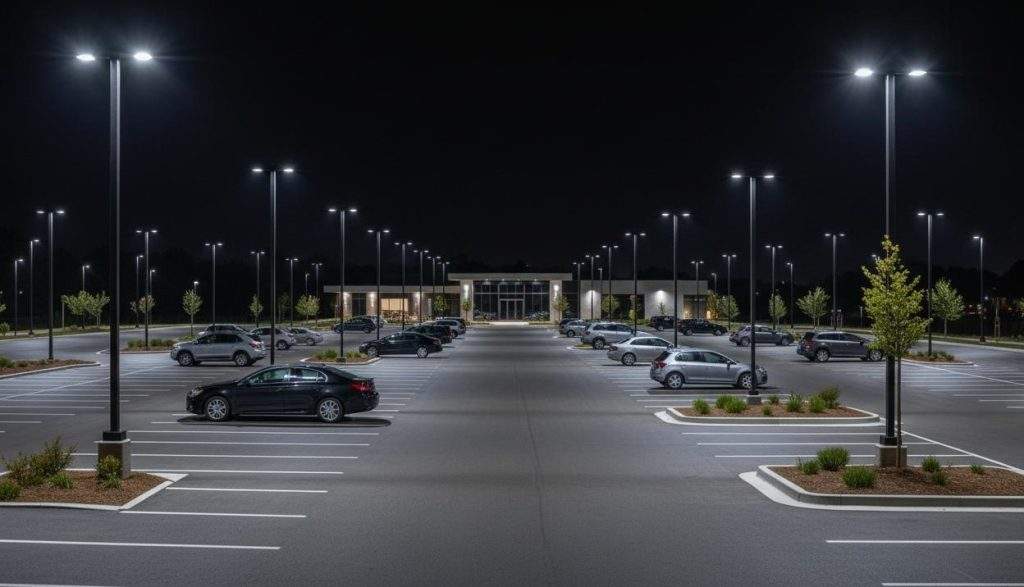
Parking lots
- General parking areas: often around 0.5 to 2 fc.
- Higher-focus zones such as entries, pedestrian crossings, or pay areas: often higher depending on the use and risk.
Parking lot lighting should stay uniform. A low average can still work if the layout is even and the critical pedestrian zones are supported. If the edges collapse into dark spots, the design usually needs correction.
For deeper outdoor guidance, see Outdoor Lighting Foot-Candle Requirements.
Warehouses
- General storage and circulation: often around 10 to 20 fc.
- Picking, packing, and more detail-oriented work: often around 20 to 50 fc or more depending on the task.
Warehouses depend heavily on task type, rack height, aisle geometry, and whether the design needs stronger vertical illumination.

Offices
- Open office and general desk work: often around 30 to 50 fc.
- More detailed administrative or technical tasks: often higher where needed.
Office lighting should not be judged by brightness alone. Glare control, screen comfort, vertical brightness, and dimming flexibility all matter.
Classrooms
- General classroom areas: often around 30 to 50 fc.
- Teaching surfaces, labs, and more detailed educational tasks: often higher where the task requires it.
Classroom lighting should support both visibility and comfort. Poor glare control can be just as disruptive as low light levels.
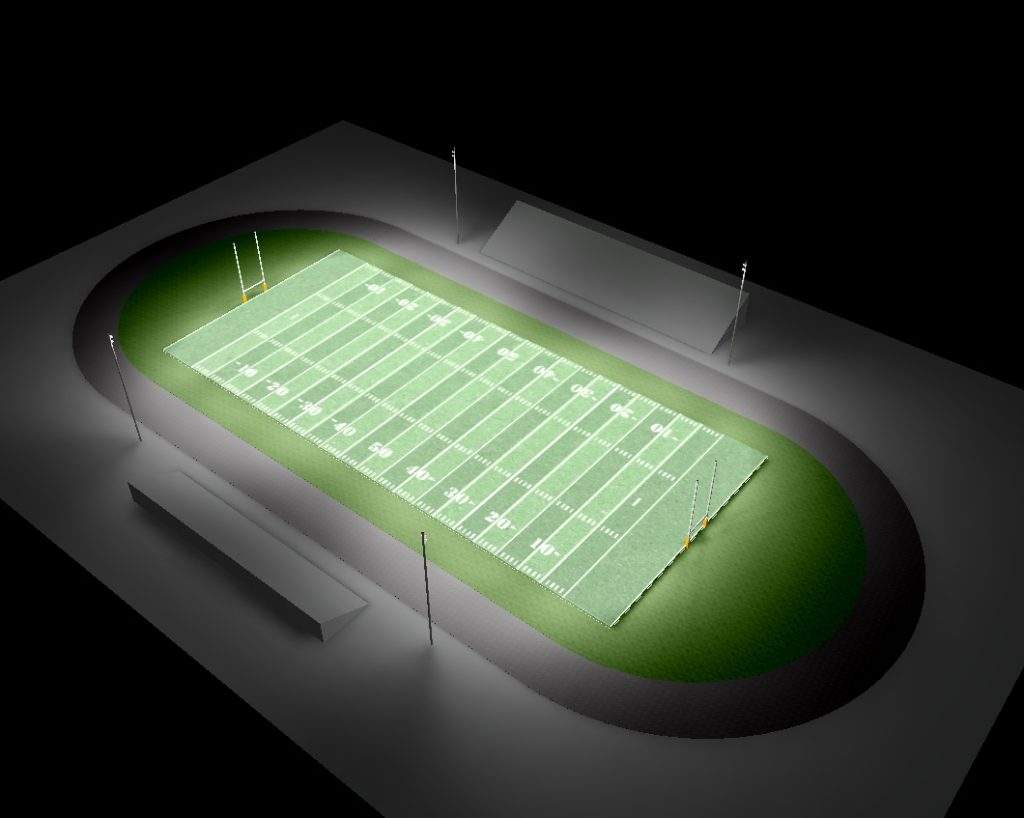
Sports fields and sports facilities
Sports lighting varies the most because the target depends on the level of play, the type of sport, whether spectators or cameras are involved, and the size of the venue.
- Recreational fields and courts: typically much lower than competitive venues.
- Competitive and broadcast-oriented sports: require much higher light levels, tighter uniformity, and stronger glare control.
If the project involves baseball or softball, see Baseball and Softball Field Lighting Photometric Planning Basics.
Why average foot-candles are not enough
Two spaces can show the same average foot-candle value and still perform very differently. The difference is usually uniformity.
- average foot-candles
- minimum foot-candles
- uniformity ratios
- glare risk
- property-line values on outdoor projects
A parking lot with a strong average but weak minimums will still feel patchy. An office with acceptable average light but poor glare control can still feel uncomfortable. A sports field with high light levels and bad uniformity can still perform poorly.
What changes the target foot-candle level
- task difficulty
- age and expectations of the users
- viewing distance
- contrast needs
- ceiling or mounting height
- reflectances and surface color
- code or owner standards
- whether the project is indoor, outdoor, pedestrian, vehicular, or sports-related
This is why a rule-of-thumb chart is only the first step.
When you need a photometric plan
If the project needs permit review, construction confidence, or reliable fixture spacing, the target foot-candle range should be validated with a layout. A professional photometric plan helps confirm how the site or room actually performs.
- the space has multiple activity zones
- mounting heights are high
- the project has glare or spill-light sensitivity
- the owner is comparing fixture options
- the project may be reviewed by an AHJ or consultant
FAQ
What is a foot-candle?
A foot-candle is a measure of illuminance. It tells you how much light reaches a surface.
Are foot-candle requirements fixed by code?
Not always. Many projects use recommended practice, owner standards, and risk-based design decisions. Code may still affect parts of the design depending on the space and jurisdiction.
Can I use the same foot-candle target for every room?
No. Different tasks, surfaces, and user needs require different light levels.
Why should I care about uniformity?
Because average brightness alone does not tell you whether the light is even, usable, or visually comfortable.
Need to verify the target levels on your project?
If you need to validate foot-candle targets for a parking lot, warehouse, office, classroom, or sports project, Stetra Lighting can prepare a photometric plan that shows actual light levels, fixture spacing, and uniformity before installation.
Final Conclusion
Foot-candle requirements by area are useful only when they are applied in context. The right target depends on the task, the layout, the level of uniformity, and the project constraints. Use the chart as a starting point, then validate the real design with a photometric plan when accuracy matters.