
A professional lighting plan is the technical blueprint that guarantees a project’s lighting system will meet performance, safety, and code requirements. It uses photometric analysis to predict and verify light behavior before installation, aligning architects, engineers, and contractors.
This document translates a design concept into a predictable and compliant system. It is essential for commercial, industrial, and site lighting projects where safety and operational efficiency are critical. The plan replaces assumptions with data-driven simulations to validate design decisions.
The Purpose of a Lighting Plan

The primary purpose of a lighting plan is to ensure the final installation performs as specified, preventing costly errors and rework. It uses photometric calculations to verify design choices against project requirements and regulatory standards.
For architects, engineers, and property owners, the plan serves as a crucial risk mitigation tool. It provides documented proof that the proposed lighting solution will achieve all functional and safety objectives.
Defining Technical Requirements
A lighting plan establishes clear, measurable technical specifications. These parameters ensure all stakeholders are working from a unified set of criteria.
A professional lighting plan defines:
- Illuminance Levels: Specifies required light levels in foot-candles (fc) for different areas and tasks, based on Illuminating Engineering Society (IES) recommendations.
- Fixture Placement and Aiming: Details the precise location, mounting height, and orientation of each luminaire to achieve the intended light distribution.
- Glare and Light Trespass Control: Sets limits for visual comfort and light pollution using metrics like UGR (Unified Glare Rating) for interiors and BUG (Backlight, Uplight, Glare) ratings for exteriors.
- Code Compliance Verification: Provides calculations and documentation to prove the design adheres to energy codes, safety standards, and local ordinances.
The lighting plan becomes the single source of truth for the entire lighting system.
Core Components of a Compliant Lighting Plan

A compliant lighting plan is a set of technical documents that validate the design for performance, safety, and permitting. These components form a complete blueprint that eliminates ambiguity.
The foundation is the photometric plan, a visual layout showing light distribution. It uses contour lines (isolines) to illustrate how foot-candle levels vary across a surface, identifying potential bright spots or shadows before construction begins.
Essential Data and Schedules
A compliant plan must include quantitative data to validate the design against industry standards.
Key components include:
- Illuminance Calculation Summaries: Tables confirming that light levels (minimum, maximum, and average) meet IES targets for the application.
- Fixture Schedules: A detailed inventory of all luminaires, specifying model numbers, lumen output, wattage, color temperature (CCT), and optics.
- Performance Metrics: Calculations quantifying uniformity ratios to ensure even light distribution and glare control metrics like UGR for visual comfort.
- Controls Narrative: A description of how the lighting system operates, including dimmers, sensors, and timers required to meet energy codes.
Compliance and Permitting Documentation
For exterior lighting, the plan must address light pollution. The BUG (Backlight, Uplight, Glare) rating for each specified fixture is critical for demonstrating compliance with local ordinances.
Many jurisdictions require proof of adherence to dark-sky initiatives. A detailed explanation of these requirements can be found in our guide to dark sky compliant lighting.
Submitting a complete and accurate photometric plan is essential for a smooth permitting process. A permit-ready photometric plan from a provider like Stetra Lighting consolidates all necessary calculations and documentation to demonstrate code compliance and expedite approvals.
Key Performance Metrics You Must Quantify
A professional lighting plan is driven by data. It must quantify key performance metrics to provide objective proof that the system will function as intended. These metrics are critical for evaluating safety, visual comfort, and code compliance.
Illuminance uniformity is a primary metric. Ratios, such as average-to-minimum, are used to prevent hazardous dark spots in parking lots, warehouses, and other critical areas. Our detailed guide to lighting uniformity ratios offers a deeper look at these calculations.
Glare and Light Pollution Control
Light quality is as important as quantity. For interior applications, the Unified Glare Rating (UGR) quantifies visual discomfort, which can directly impact occupant productivity and well-being.
For exterior luminaires, BUG ratings (Backlight, Uplight, and Glare) are essential for controlling light trespass and skyglow. These ratings are necessary to meet local light pollution ordinances. The push for efficiency and control is a major factor in the lighting market’s growth, which is expected to reach USD 189.93 billion by 2030. You can explore these lighting market trends on Mordor Intelligence.
Navigating Lighting Codes and Industry Standards
A formal lighting plan is the primary tool for demonstrating compliance with the complex regulations governing U.S. lighting projects. It provides documented evidence that the design meets multiple layers of legal requirements, ensuring a smoother permitting process.
Adhering to these codes from the outset is crucial for avoiding costly violations and project delays.
Balancing Performance and Efficiency
Lighting design requires balancing IES performance recommendations with stringent energy efficiency codes. The Illuminating Engineering Society (IES) provides guidelines for light levels and quality necessary for occupant comfort and task performance.
Simultaneously, energy codes like ASHRAE 90.1 and California’s Title 24 impose strict limits on lighting power density (LPD) and mandate advanced controls.
Exterior lighting is also heavily regulated. Many municipalities have dark-sky ordinances that restrict light trespass and require fixtures with specific BUG ratings. As the LED market grows to a projected USD 285.39 billion by 2035, a photometric plan is the only way to prove a design meets these dual demands for performance and efficiency. Read more in this LED lighting market analysis.
The Workflow From Concept to Approval

A professional lighting plan follows a structured, iterative process. The workflow begins with analyzing architectural plans and project requirements to define the constraints, including energy codes and safety standards.
This initial discovery phase establishes the performance criteria that guide the entire design and simulation process.
Modeling and Simulation
The design is developed in specialized software like DIALux. A 3D model of the space is created, and surfaces are assigned reflectance values to simulate real-world conditions accurately.
Luminaires are placed in the virtual model using their specific IES files. An IES file contains the photometric data that describes a fixture’s unique light distribution pattern. This data is essential for accurate simulation.
The simulation phase validates the design. Calculations are run iteratively, adjusting fixture spacing, mounting heights, and beam angles until all performance targets—from foot-candle levels to uniformity ratios—are met.
Final Deliverables and Approval
Once simulations confirm the design meets all performance and compliance targets, the final documentation is assembled. This package serves as the official guide for architects, contractors, and inspectors. See our guide on how to read a photometric plan for a breakdown of these documents.
Key deliverables include:
- Photometric Reports: Detailed calculation results, isolux diagrams, and optional 3D renderings that provide proof of performance.
- Fixture Schedules: A complete list of all luminaires with specifications, quantities, and part numbers.
- Control Intent Narratives: A clear explanation of the control system’s design and operational sequence.
Common Mistakes to Avoid in Lighting Plans
Errors in a lighting plan can lead to safety hazards, code violations, and costly rework. A proper photometric analysis helps avoid these issues by replacing assumptions with verified data.
Common mistakes include specifying incorrect foot-candle targets, resulting in over-lit spaces that waste energy or under-lit spaces with poor visibility. Poor uniformity is another frequent error that compromises visual comfort and safety.
Technical Oversights in Modeling
Several technical errors can invalidate a lighting plan’s calculations. Using incorrect or outdated IES files is a critical mistake, as it produces an inaccurate simulation of the fixture’s performance.
Other common technical oversights include:
- Ignoring Surface Reflectances: Failing to account for the color and finish of walls, floors, and ceilings will lead to inaccurate illuminance calculations.
- Incorrect Mounting Heights: Minor deviations from specified mounting heights can significantly alter light levels and uniformity.
- Neglecting Glare Control: Overlooking metrics like UGR can result in a visually uncomfortable or disabling environment.
The global lighting market, valued at USD 142,514.5 million in 2025, is driven by efficient LEDs that require precise calculations. A professional lighting plan mitigates these risks and ensures a successful installation. More details are available in this lighting product market report.
Why 3D Renders Add Value to a Technical Plan
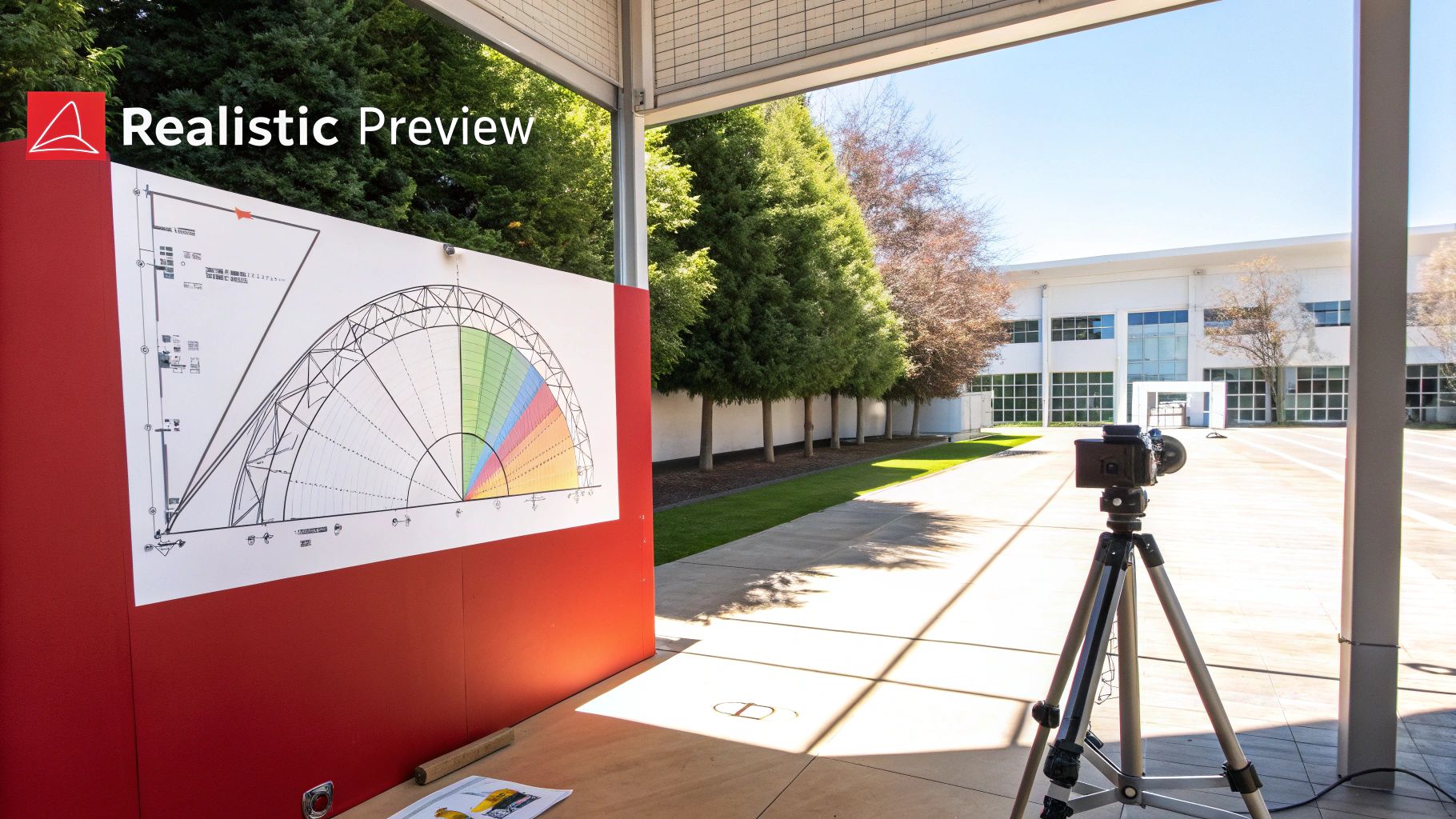
While quantitative data forms the foundation of a lighting plan, 3D visualizations translate that data into a tangible preview of the finished space. They are a powerful communication tool for stakeholders who are not lighting experts.
These renderings are generated from the same photometric model used for the technical calculations. This ensures they provide a data-driven, accurate preview of how the environment will look and feel.
Bridging the Gap Between Data and Design
A visualization illustrates light distribution, shadow patterns, and the interaction of light with materials and textures. It provides clear, visual answers to critical design questions before construction begins.
This visual confirmation is valuable for aligning stakeholders:
- For architects, renderings confirm the lighting design aligns with their aesthetic intent and properly highlights key architectural features.
- For owners, they build confidence by showing exactly what the investment will produce, which helps secure project approval.
- For contractors, they provide visual context to technical drawings, reducing ambiguity and the risk of installation errors.
A rendering translates abstract foot-candle values and uniformity ratios into the tangible look and feel of a well-lit environment, ensuring the final outcome aligns with stakeholder expectations.
Visualizations are an effective tool for communicating the value of a technical lighting plan. For projects requiring stakeholder buy-in, consider a professional lighting visualization.