

Light Glare Explained
Light glare is excessive brightness or contrast that causes visual discomfort or reduces visibility. It can happen indoors or outdoors, and it often shows up when the source is too bright, too exposed, poorly aimed, or badly matched to the space.
That is why glare is not only a comfort issue. It is a performance issue. A space can meet its light-level target and still feel harsh, tiring, or difficult to use if the glare is not controlled.
This guide explains the main types of glare, what causes them, and how to reduce glare in real lighting projects.
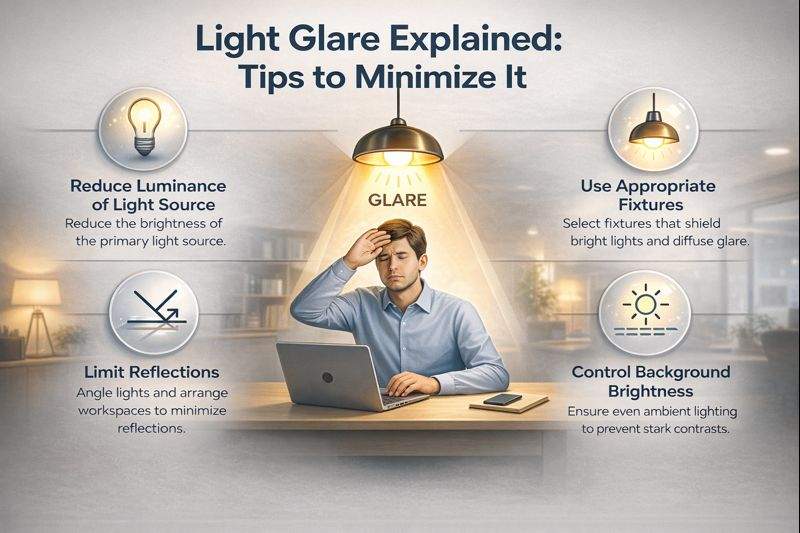
What glare actually depends on
Glare is influenced by more than raw output. It depends on the relationship between the source, the viewer, and the surrounding brightness.
- source brightness
- viewing angle
- beam angle
- background contrast
- mounting height and placement
- surface reflectance
This is why the same fixture can feel comfortable in one space and harsh in another.

Disability glare vs. discomfort glare
Discomfort glare
Discomfort glare causes annoyance or discomfort without necessarily reducing visibility. The IES definition of discomfort glare distinguishes this sensation from a measurable reduction in visual performance. A bright exposed source can be uncomfortable even when the task remains visible.
Disability glare
Disability glare occurs when stray light in the eye reduces retinal-image contrast and can reduce visibility or visual performance. The IES definition of disability glare explains why a bright source can make a nearby target harder to see. The same installation may produce both effects.
Reflected glare
Reflected glare describes a light path: the source is seen through a reflection from glass, a screen or another glossy surface. Direct and reflected sources can cause discomfort or reduced visibility; they are not mutually exclusive categories alongside the two effects above.
Common causes of glare
- an exposed bright source in a direct sight line
- the wrong beam angle for the mounting condition
- too much output in a small or reflective space
- poor shielding or cutoff
- fixtures placed too low or too close to the viewer
- strong contrast between the source and its surroundings
In exterior lighting, glare often comes from wall packs, floodlights, parking lot poles, or facade fixtures that are aimed too aggressively. Indoors, it often comes from downlights, linear fixtures, decorative luminaires, or reflected brightness on work surfaces and screens.
Why glare matters
Glare affects comfort, visibility, and perceived quality. It can make a well-finished project feel cheap or poorly planned. It can also reduce productivity, create complaints, and make night environments feel less safe instead of more safe.
This is why glare control should be part of the lighting layout from the beginning, not a last-minute fix.
How to reduce light glare
Choose optics that match the space
Compare optics at the actual mounting height, setback and aiming. A narrower beam may reduce unwanted light in one arrangement and create a more intense visible source in another. Our downlight beam-angle guide explains why the geometry and distribution must be considered together.
Control the source visibility
Use shielding, cutoff, recessing, or better mounting position so the bright source is less exposed to normal viewing angles.
Check fixture spacing and aiming
Overlapping hot spots and badly aimed fixtures can create harsh contrast. Often the right answer is a better layout, not more output.
Use dimming and controls when appropriate
Dimming, schedules and occupancy controls can reduce output when appropriate, but confirm the required task levels and operating conditions before changing the setting. See our lighting-controls guide for zoning and commissioning considerations.
Pay attention to reflections
Glare is not always direct. Glossy surfaces, screens, polished stone, and glass can all amplify the problem.

For the fixture inputs and calculation process, see our photometric-analysis guide. Calculated results and field measurements serve different purposes; identify which evidence a review uses.
When a photometric review helps with glare
A horizontal foot-candle grid does not directly measure glare. A review also needs the luminaire distribution, apparent source brightness and size, viewing positions, aiming and background conditions. Select the glare-evaluation method for the application and state its assumptions. IES research on outdoor discomfort-glare models describes the limits of treating outdoor glare as one universal metric.
For site lighting, a parking lot photometric plan can compare the layout, shielding, aiming and boundary results. A fixture’s BUG rating is useful input, but it does not by itself prove that an installed site will have acceptable glare. For a calculation review, send the site plan and fixture data.
FAQ
What is light glare?
Light glare is excessive brightness or contrast that causes discomfort or reduces visibility.
What is the difference between discomfort glare and disability glare?
Discomfort glare is an uncomfortable sensation; disability glare reduces visual performance through contrast loss. They can occur together. A useful review identifies the source, viewing position and surrounding brightness rather than judging glare from wattage or average foot-candles alone.
Can glare happen even if the light level is correct?
Yes. A project can meet its foot-candle target and still feel harsh if the source visibility, beam angle, or contrast is wrong.
How do you reduce glare outdoors?
Use better shielding, better optics, sensible mounting heights, and a layout that limits hot spots and unnecessary spill light.
Need help reducing glare before installation?
If your project has glare problems, Stetra Lighting can help review beam angle, fixture spacing, shielding, spill light, and photometric performance before the issue reaches the field.
Final Conclusion
Glare is not a minor detail. It is one of the clearest signs that a lighting layout needs better control. The right optic, spacing, shielding, and output level will usually improve both comfort and visibility more effectively than simply adding more light.