
Intelligent lighting controls are a building’s central nervous system for illumination. They move beyond simple on/off switches to create responsive and efficient environments tuned to occupants. These systems use sensors, schedules, and user inputs to make automated decisions about where and when to deliver light.
The Role of Intelligent Lighting Controls in Building Design
For architects, engineers, and property owners in the United States, intelligent lighting controls are a foundational component of modern building design. They provide a practical framework for achieving critical performance targets and operational goals. These systems deliver the right amount of light only where and when it is needed, transforming lighting from a static utility into a dynamic, adaptive building system.
Core Objectives and Benefits
A well-designed control system is specified to meet three interconnected goals: energy efficiency, occupant experience, and code compliance. Neglecting any one of these can compromise building performance or cause project delays.
Integrating intelligent lighting controls provides measurable benefits:
- Reduced Operational Costs: Systems can reduce lighting energy consumption by up to 80% when paired with LEDs by automatically dimming or turning off lights in unoccupied areas or when daylight is sufficient.
- Enhanced Occupant Well-Being: Controls enable personalized lighting and support human-centric design principles. For example, a proper implementation of circadian rhythm lighting can improve productivity, comfort, and health.
- Simplified Facility Management: Centralized dashboards and automated schedules streamline maintenance and operations. Facility managers can monitor and adjust performance across zones or entire buildings.
Key Technologies and Communication Protocols
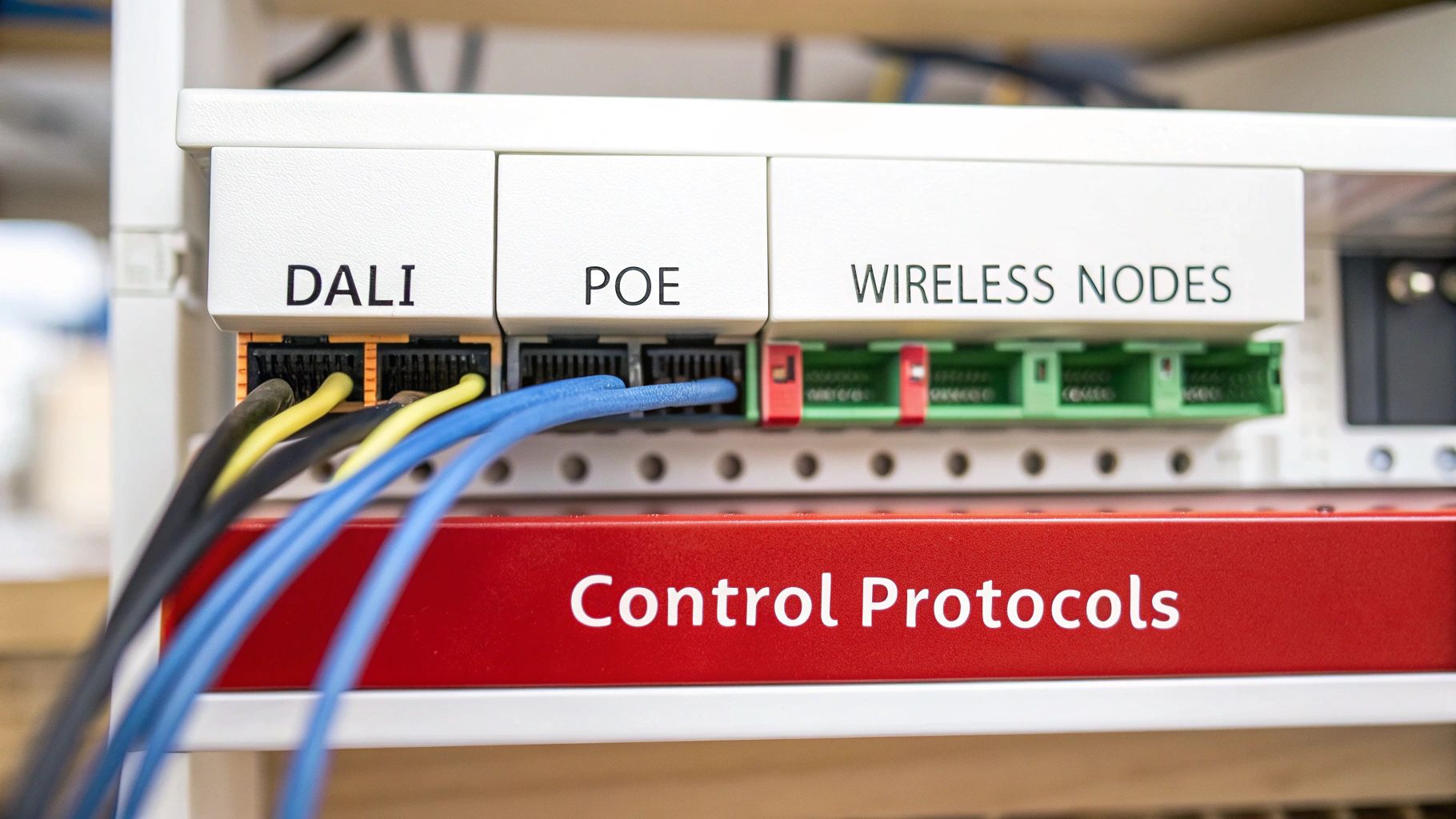
Understanding communication protocols is essential for specifying effective intelligent lighting controls. These protocols are the language that fixtures, sensors, and controllers use to send and receive commands. The choice between wired and wireless protocols shapes system capabilities, installation complexity, and total project cost.
The global lighting control market is projected to reach USD 26 billion by 2026. This growth underscores the importance of selecting a future-ready protocol. You can explore detailed market growth insights on arizton.com for more information.
Wired Control Protocols
Wired systems are known for their reliability and are a common choice for new construction projects where running low-voltage wiring is straightforward. A hardwired connection provides a stable and secure communication backbone that is immune to the signal interference that can affect wireless systems.
- 0-10V Dimming: This analog system is commonly used for basic dimming functions. It employs a DC voltage signal ranging from 0 to 10 volts to adjust the brightness of luminaires. While it is simple and compatible with many fixtures, a key limitation is that all lights on a single circuit dim simultaneously.
- DALI (Digital Addressable Lighting Interface): DALI is a digital system that assigns each fixture a unique address, allowing for individual control, detailed energy tracking, and intricate scene setting. It is ideal for environments requiring precise control, such as conference rooms or architectural exteriors.
- Power over Ethernet (PoE): PoE utilizes standard network cables to transmit both power and data to LED fixtures. This method simplifies installation by removing the need for separate electrical wiring and integrating the lighting system with the building’s IT network.
- Phase Dimming: This method involves altering the power waveform to adjust light levels. It is typically used with incandescent and some LED lights. Although it is a straightforward approach, compatibility with LEDs may vary, requiring careful selection of compatible components.
- DMX (Digital Multiplex): DMX is a protocol often used in theatrical and architectural lighting. It provides precise control over an extensive range of fixtures, allowing for intricate lighting effects and scene changes. This makes it suitable for dynamic environments like theaters and event spaces.
Wireless Control Protocols
Wireless protocols offer significant flexibility, especially for retrofits in existing buildings where installing new wiring is impractical or cost-prohibitive. They can reduce labor costs and installation time. The primary advantage of wireless controls is scalability, allowing devices to be added or moved with minimal physical disruption as space requirements evolve.
Common wireless protocols include Zigbee and Bluetooth Mesh. These protocols create robust networks where devices communicate directly, extending signal range and enhancing reliability without a central hub. They are suitable for phased projects or systems expected to expand.
Essential Control Strategies for Energy Compliance
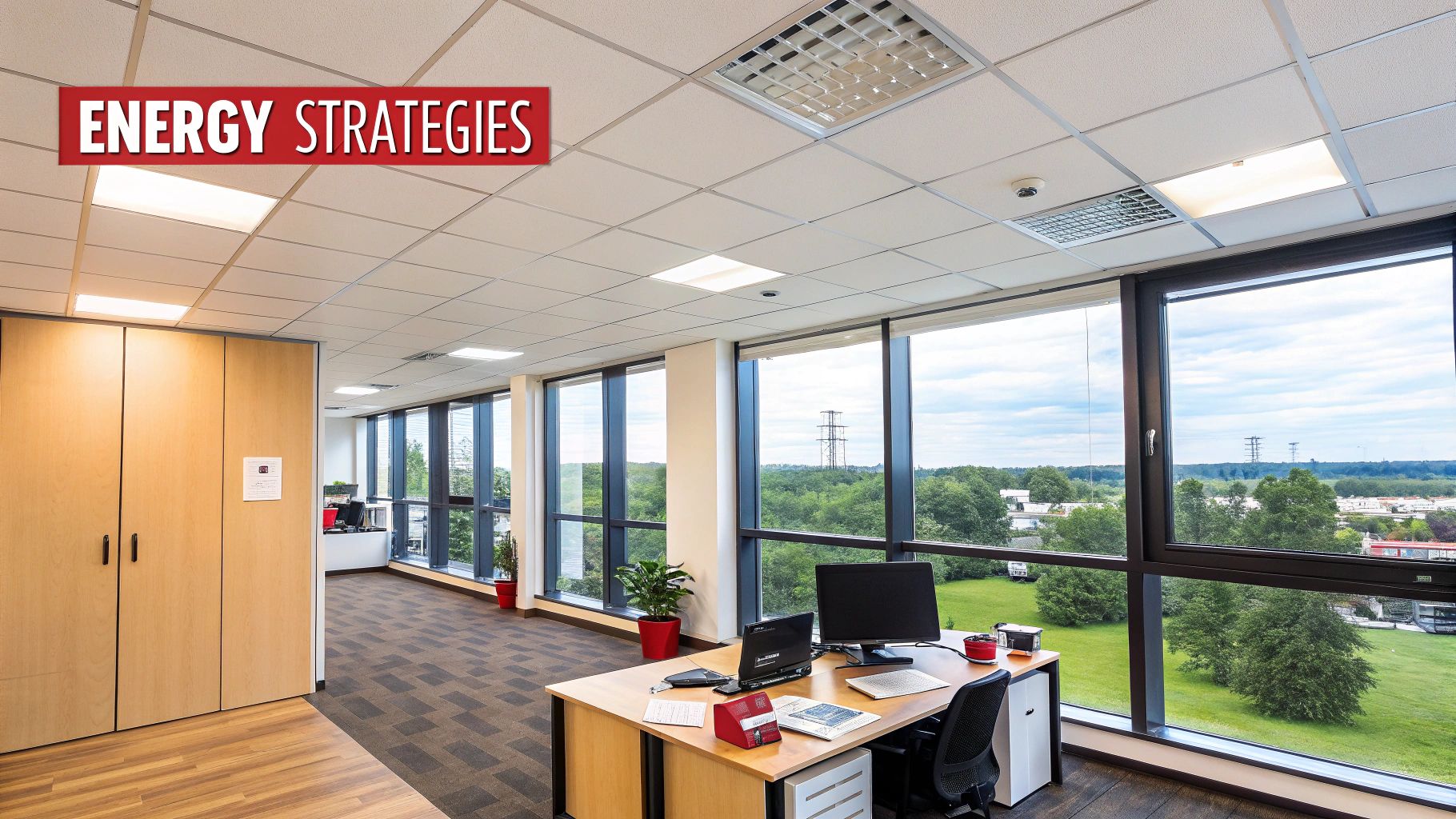
Modern U.S. energy codes, such as ASHRAE 90.1 and California’s Title 24, mandate specific control strategies to eliminate wasted energy. These are foundational requirements for any compliant lighting design. When combined with modern LEDs, these strategies can reduce lighting energy consumption by up to 80%. These savings are a key driver in global sustainability efforts, as detailed on mordorintelligence.com.
The Four Pillars of Compliant Control
These four methods are the building blocks of energy-efficient lighting systems. Most modern codes require them to work in concert.
- Time-Based Scheduling: This is the first line of defense against energy waste. The system automatically turns lights on, off, or to a dimmed state based on a predetermined schedule. It is ideal for spaces with predictable occupancy, such as offices or retail stores.
- Occupancy and Vacancy Sensing: Sensors address unpredictable human presence. Occupancy sensors automatically turn lights on when a person enters a room and off after it is empty. Vacancy sensors require manual-on operation but provide automatic-off functionality. The manual-on approach is required in many jurisdictions to prevent lights from activating unnecessarily.
- Daylight Harvesting: This strategy utilizes natural light to reduce electric light usage. Photosensors measure the amount of daylight entering a space through windows or skylights. The control system then dims the electric lights to maintain the target light level, maximizing energy savings.
- Task Tuning (High-End Trim): New luminaires often produce more light than necessary. Task tuning sets a maximum brightness level for a space, capping the output below 100%. This adjustment prevents over-lighting and ensures light levels are appropriate for the activities performed in the area. Our guide on foot-candle requirements by area provides target illuminance levels.
Integrating Controls with Photometric and Architectural Plans
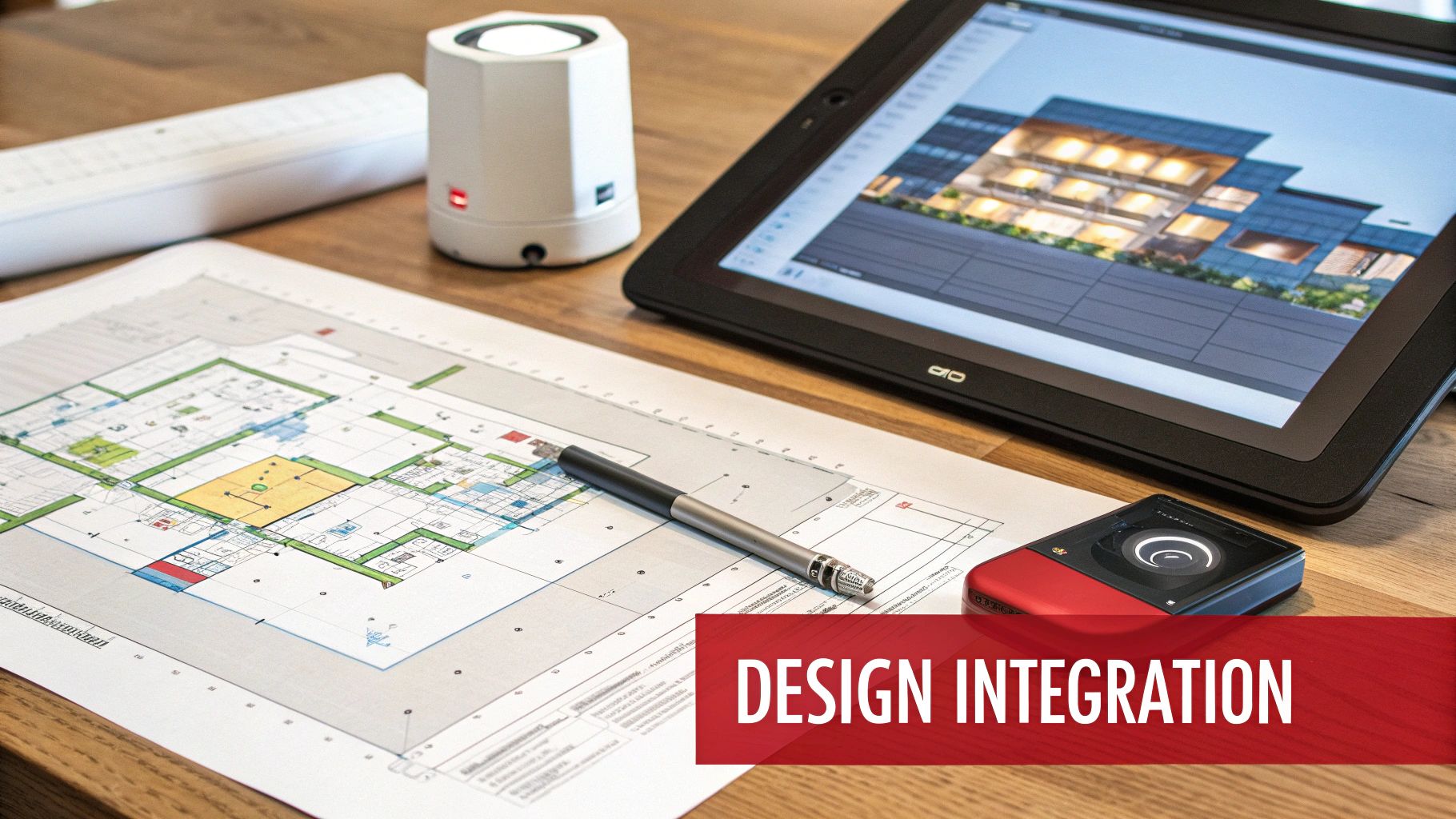
Effective intelligent lighting controls must be integrated into a building’s design from the initial planning stages. Control system design should occur in parallel with architectural and photometric planning to ensure seamless performance and code compliance. Treating controls as an afterthought can lead to sensor dead spots, poor user experience, and wasted energy.
The objective is to align the control strategy with the functional use of each space. This requires more than simply placing sensor icons on a floor plan.
While intelligent lighting controls improve efficiency and flexibility, their performance depends on accurate lighting calculations.
Photometric plans are used to verify baseline light levels, uniformity, and compliance before controls are applied. This ensures that dimming, scheduling, and occupancy strategies operate on a properly designed lighting system rather than compensating for poor distribution.
Aligning Control Zones with Building Function
Control zoning must reflect real-world activity. For example, a large open office requires different control zones for workstations near windows versus interior collaboration areas with no daylight exposure.
Key considerations for alignment include:
- Sensor Placement: Position occupancy sensors to accurately detect presence within their intended zone while avoiding false triggers from adjacent areas, such as hallways.
- Daylight Zones: Map daylight harvesting zones based on window locations and the penetration of natural light. Place photosensors where they can measure daylight levels accurately.
- Task-Specific Zones: Create dedicated zones for specific activities. Conference rooms, task areas, and circulation paths should have lighting levels tailored to their functions.
A common mistake is creating control zones that conflict with the architectural layout, such as a single sensor controlling lights on both sides of a partition wall. This defeats the purpose of granular control. Successful integration ensures the lighting system performs in reality as it did in the simulation. For further reading, see this practical guide to photometric analysis.
Choosing the Right Controls for Different Applications
The success of intelligent lighting controls depends on matching the strategy to the application. A one-size-fits-all approach is ineffective. The lighting requirements of a commercial office differ significantly from those of a parking lot or an architectural facade.
Commercial buildings represent approximately 58% of the lighting controls market, driven by a clear return on investment from energy management. You can see more data on these intelligent lighting trends on alliedmarketresearch.com.
Commercial and Workplace Interiors
Office lighting design must balance occupant comfort with energy efficiency. This requires layered, granular control strategies.
- Occupancy and Vacancy Sensing: Essential for private offices, conference rooms, and restrooms to eliminate lighting in unoccupied rooms.
- Daylight Harvesting: Critical for perimeter zones near windows. Sensors automatically dim fixtures when sufficient natural light is present.
- Task Tuning: Allows facility managers to set maximum light levels, preventing over-lighting and enabling users to adjust light for specific tasks.
A well-executed interior control system creates a more productive environment. Our guide to workplace lighting offers more detail on this topic.
Parking Lots and Large Outdoor Areas
For exterior applications like parking lots, priorities shift to safety, security, and code compliance.
Bilevel motion sensing is a key strategy. Fixtures operate at a low, energy-saving level when the area is empty, then increase to full brightness upon motion detection. Time-based scheduling is also vital for automatically lowering light levels after business hours while maintaining minimum required foot-candles for security.
A common mistake in exterior lighting is failing to control glare and light trespass. A well-designed system must adhere to local ordinances and consider luminaire BUG (Backlight, Uplight, Glare) ratings to prevent light from spilling onto adjacent properties.
Achieving Code Compliance and Project Approval
A documented intelligent lighting controls system is non-negotiable for project permitting. U.S. building departments enforce strict energy codes like ASHRAE 90.1 and Title 24, which demand verifiable proof that a design meets targets for lighting power density and control performance. Inadequate documentation leads to costly revisions and approval delays.
Validating Your Design for Permitting
Plans submitted to the local authority having jurisdiction (AHJ) must detail the control system’s operation. This includes sensor locations, control zones, and automated schedules. Each element must be justified to prove it contributes to the building’s energy savings and safety. A disconnect between the specified luminaires and the control strategy is a frequent point of failure.
To ensure a smooth approval process, the design must be validated before submission. Professionals at Stetra Lighting provide permit-ready photometric plans that cross-reference lighting and control specifications against current code requirements. This documentation provides the evidence needed for compliance. You can learn more in our simple guide to photometric analysis. Verifying that your design meets all requirements before installation is a critical step, and for this, you can order a photometric plan to get the official documentation needed to satisfy compliance standards.