
Foot-candles and lux measure the same thing: illuminance on a surface. The difference is the unit system. In the U.S., plans and specifications often use foot-candles. In most other countries and many fixture tools, you will see lux.
This guide shows the difference between foot candles vs lux, the exact conversion, and quick tables you can copy into real lighting work.
What Foot-Candles and Lux Actually Mean
Both units describe how much light reaches a surface. Think of it as “light on the table,” not “light coming out of the fixture.” This matters in photometric plans, lighting calculations, and code compliance.
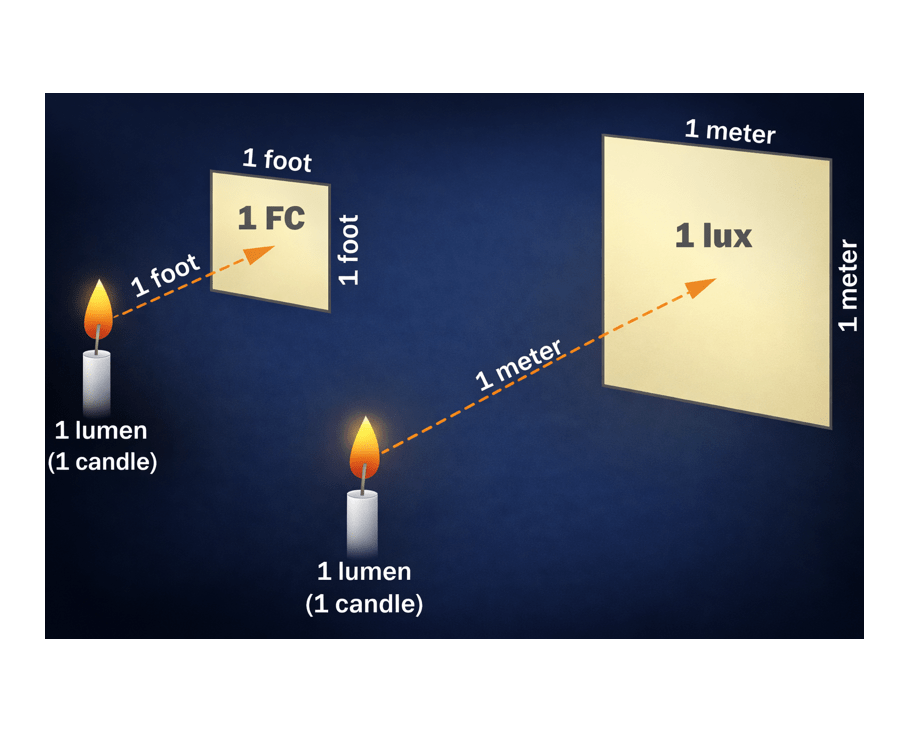
Here is the core idea:
- Foot-candle (fc): illuminance per square foot (used widely in U.S. lighting design).
- Lux (lx): illuminance per square meter (metric standard).
- Same physics: only the area unit changes.
If you read a photometric plan and the notes say “30 fc average,” that is the same target as about “323 lux average.” The design intent is identical.
Exact Conversion Formula and Quick Tables
The conversion is fixed. No assumptions are needed.
- Lux = foot-candles × 10.764
- Foot-candles = lux ÷ 10.764
- Fast estimate: 1 fc ≈ 11 lux (use only for quick mental checks).
Practical Details
Use the exact factor when you document results for permitting or client reports. Use the quick estimate only when you are sketching early concepts.
- Specs and codes: keep the exact 10.764 factor.
- Early layout checks: 1 fc ≈ 11 lux is usually close enough.
- Always label units: “30” alone is meaningless without fc or lux.
Quick reference table (foot-candles to lux):
| Foot-candles (fc) | Lux (lx) | Typical use (example) |
|---|---|---|
| 5 | 54 | Low ambient / circulation |
| 10 | 108 | General background lighting |
| 20 | 215 | Hallways, basic task zones |
| 30 | 323 | Kitchens, offices (common targets) |
| 50 | 538 | Detailed tasks, higher visual demand |
| 100 | 1076 | Precision tasks / high visibility areas |
Reverse reference table (lux to foot-candles):
| Lux (lx) | Foot-candles (fc) | Where you might see it |
|---|---|---|
| 100 | 9.3 | Metric notes in product tools |
| 200 | 18.6 | Interior targets in EU-based references |
| 300 | 27.9 | General task lighting targets |
| 500 | 46.5 | Work areas, stronger task lighting |
| 750 | 69.7 | High-visibility task zones |
| 1000 | 92.9 | Very bright / specialized tasks |
Common Mistakes When Comparing Foot-Candles vs Lux
Most errors happen when units are missing, mixed, or assumed. These small mistakes can cause wrong targets, wrong expectations, and rework on site.
- Mistake 1: writing “30” without units. Always write “30 fc” or “300 lux.”
- Mistake 2: mixing units inside one report. Pick one unit system and convert the rest.
- Mistake 3: using lumens as if they equal lux. Lumens are output. Lux/fc are results on a surface.
- Mistake 4: ignoring mounting height and spacing. A target can change fast with geometry.
If you are creating a photometric plan, the safest workflow is: set the target in the unit your client or AHJ expects, run the calculation, then add the converted value as a note.
Get a Professional Photometric Plan
We create accurate photometric plans ready for permitting, contractor installation, and real-world performance.
Key Takeaways
- Foot-candles and lux both measure illuminance on a surface.
- Use the exact conversion: Lux = fc × 10.764 and fc = lux ÷ 10.764.
- Label units on every value, especially in photometric plans and reports.
- Use quick tables for speed, but keep the exact factor for documentation and permitting.
If you want these targets verified with real fixtures, IES files, and correct mounting heights, Stetra Lighting can produce a complete photometric plan for your project.