Proper basketball court lighting is a technical discipline. It requires a balance of illuminance, uniformity, and glare control to create a safe and competitive playing environment. The objective is to ensure clear visibility of the ball, court lines, and other players without shadows or distracting brightness.
This guide outlines the principles, requirements, and best practices for architects, engineers, contractors, and property owners in the United States. It focuses on decision-making guidance for designing compliant and effective lighting systems.
Fundamentals of Basketball Court Lighting
A successful lighting design is grounded in photometric principles. Understanding core U.S. lighting terminology is the first step toward specifying a high-performance system that meets established standards.
Core Lighting Metrics
Three key metrics determine the quality of lighting systems for basketball courts.
-
Illuminance (Foot-candles): This refers to the amount of light reaching the court surface, measured in foot-candles (fc). The necessary illuminance level varies with the level of play. For instance, a recreational court might need 30 fc, while a professional setting requires 125 fc or more, particularly for television broadcasts. For more information, refer to this resource on how many foot-candles you might need.
-
Uniformity Ratio: This metric indicates the consistency of light distribution across the court. A lower ratio signifies better uniformity. A maximum/minimum ratio of 2.0:1 ensures that the brightest spot is no more than twice as luminous as the dimmest. Good uniformity prevents distracting hot spots and shadows, enhancing visibility.
-
Color Rendering Index (CRI): CRI evaluates how well a light source shows the true colors of objects. For sports settings, a CRI of 80 or higher is recommended to ensure that uniforms, court lines, and the ball appear natural and clear.
| Metric | Recreational | Professional |
|---|---|---|
| Illuminance (fc) | 30 | 125+ |
| Uniformity Ratio | 2.0:1 | 2.0:1 |
| Color Rendering Index | 80+ | 80+ |
A well-designed system delivers the target foot-candle level evenly and with high color fidelity, directly impacting player performance and safety.
IES Illuminance and Uniformity Standards

Lighting designs must comply with standards set by the Illuminating Engineering Society (IES). These guidelines ensure safety, playability, and optimal viewing conditions for both players and spectators.
The primary reference document, ANSI/IES RP-6-15, categorizes sports facilities into four classes of play. Identifying the correct class for a project is the first step, as it determines the specific illuminance and uniformity targets.
The Four Classes of Play
The IES classification system is based on the level of competition and spectator viewing distance. This framework drives all subsequent design decisions.
Class I: Professional competition with large spectator capacities (over 5,000) and broadcast requirements.
Class II: Collegiate or semi-professional leagues with medium-sized spectator capacities (up to 5,000).
Class III: Local tournaments, training facilities, and scholastic competition with limited spectator viewing.
Class IV: Recreational or residential courts where the primary objectives are casual play and safety.
Illuminance and Uniformity Requirements
Illuminance (foot-candles) and the uniformity ratio are the two most critical performance metrics. The uniformity ratio ensures light is distributed evenly, eliminating hot spots and shadows.
For a Class I venue, the standard is a minimum of 125 fc (horizontal) with a maximum uniformity ratio of 1.7:1 (Emax/Emin). As the class of play decreases, these requirements become less stringent. Class II requires 75 fc, Class III requires 50 fc, and Class IV requires 30 fc with a uniformity ratio up to 4:1.
The uniformity ratio is as critical as the foot-candle level. Poor uniformity can compromise a player’s ability to track the ball, leading to performance issues or potential injuries. A professional design meets or exceeds these IES minimums. Learn more about how these values are applied in this guide to understanding the lighting uniformity ratio.
Key Design Principles for Luminaire Layout

Achieving target illuminance and uniformity depends on a well-engineered luminaire layout. The placement, mounting height, and aiming of each fixture are critical to distributing light evenly across the playing surface.
Incorrect mounting height is a common design failure. Fixtures mounted too low create significant glare for players. Fixtures mounted too high can result in insufficient light reaching the court, creating dark spots. The optimal mounting height delivers the required illuminance without compromising visual comfort.
Common Layout Configurations
For outdoor courts, the pole layout is the most important factor in achieving proper light coverage and shadow control.
4-Pole Layout: This is a standard configuration for most recreational and Class IV courts. One pole is placed near each corner outside the court boundary. This cost-effective design requires precise fixture optics to project light effectively toward the center court without creating a dark zone.
6-Pole Layout: For higher levels of play such as Class II and III, a 6-pole layout is recommended. Adding a pole at the mid-court line on each side significantly improves uniformity. These additional mounting points mitigate shadows and create a more consistent playing surface.
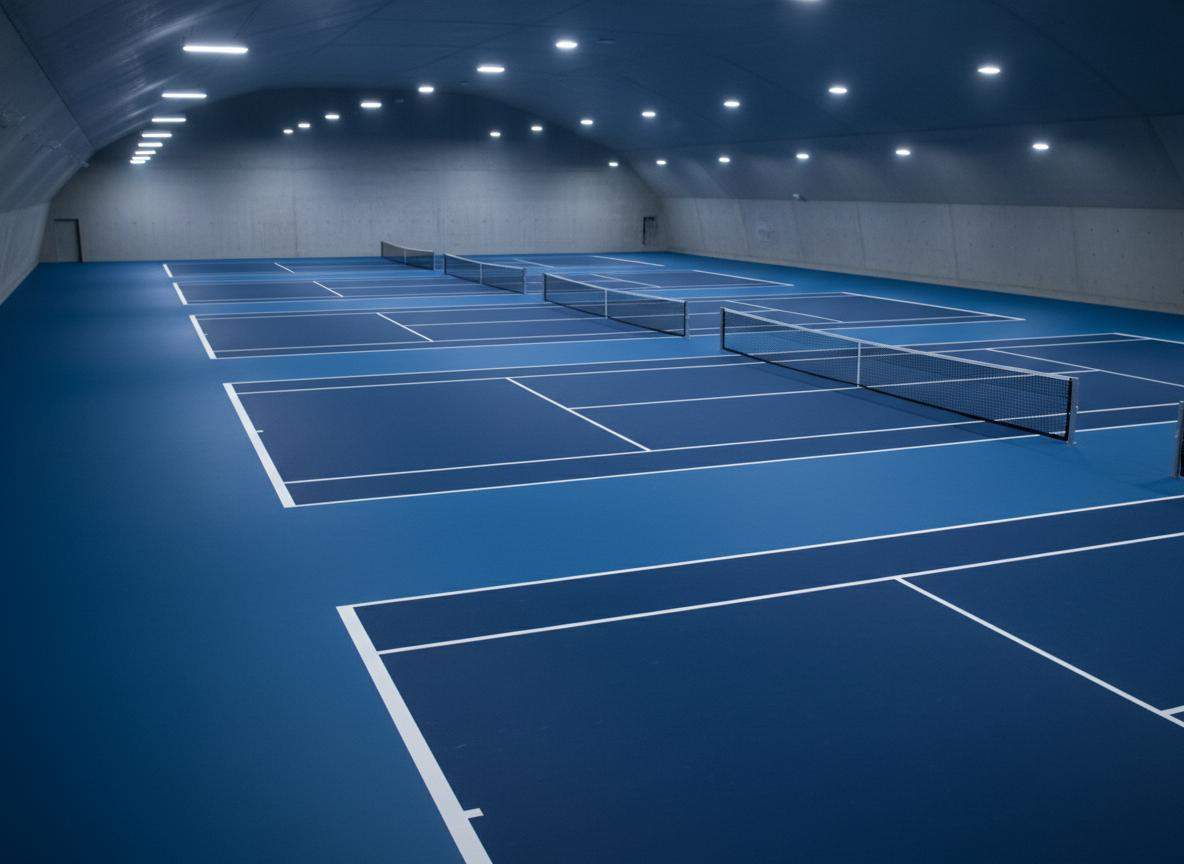
For indoor applications, luminaires are typically mounted to the ceiling or suspended from trusses. The layout should align with the primary playing area, with fixtures positioned to illuminate the court from above and slightly to the sides. Placement directly over the court can interfere with high-arcing shots and should be avoided.
Proper luminaire spacing is essential to prevent hot spots and ensure consistent coverage. Every layout must be validated with a photometric analysis to verify it meets IES standards.
Fixture Selection and Glare Control
Selecting the correct luminaire involves more than meeting a lumen output target. It requires precise control over light distribution. The fixture’s optics and beam pattern are what differentiate a compliant lighting plan from an ineffective one.
Proper fixture selection begins with understanding light distribution, often defined by IES classifications. For outdoor courts, Type III or Type IV distributions are common. These optics are designed to project light forward and across a surface from a side-mounted position, ideal for pole applications. The selected beam angle must correspond to the mounting height and pole layout to ensure light reaches the center court without causing off-site spill.
Managing Glare and Light Trespass
Glare control is a non-negotiable requirement for safety and playability.
For indoor facilities, the primary metric is the Unified Glare Rating (UGR). A low UGR value signifies better glare control, which is critical for players tracking a ball against a bright ceiling. Further details are available in this article on understanding UGR in sport lighting.
For outdoor facilities, the focus shifts to minimizing light trespass (spill light) and skyglow. A fixture’s BUG rating (Backlight, Uplight, and Glare) is the key tool for compliance.
A fixture with a low BUG rating, particularly a U0 rating for zero uplight, is essential for dark-sky compliance and preventing disturbances to adjacent properties.
External shields or visors can be added to luminaires to provide sharp cutoff and block stray light. By selecting fixtures with superior optical control and appropriate BUG ratings, designers can ensure light is directed only where it is needed: on the court.
Using Photometric Analysis for Compliance and Permitting

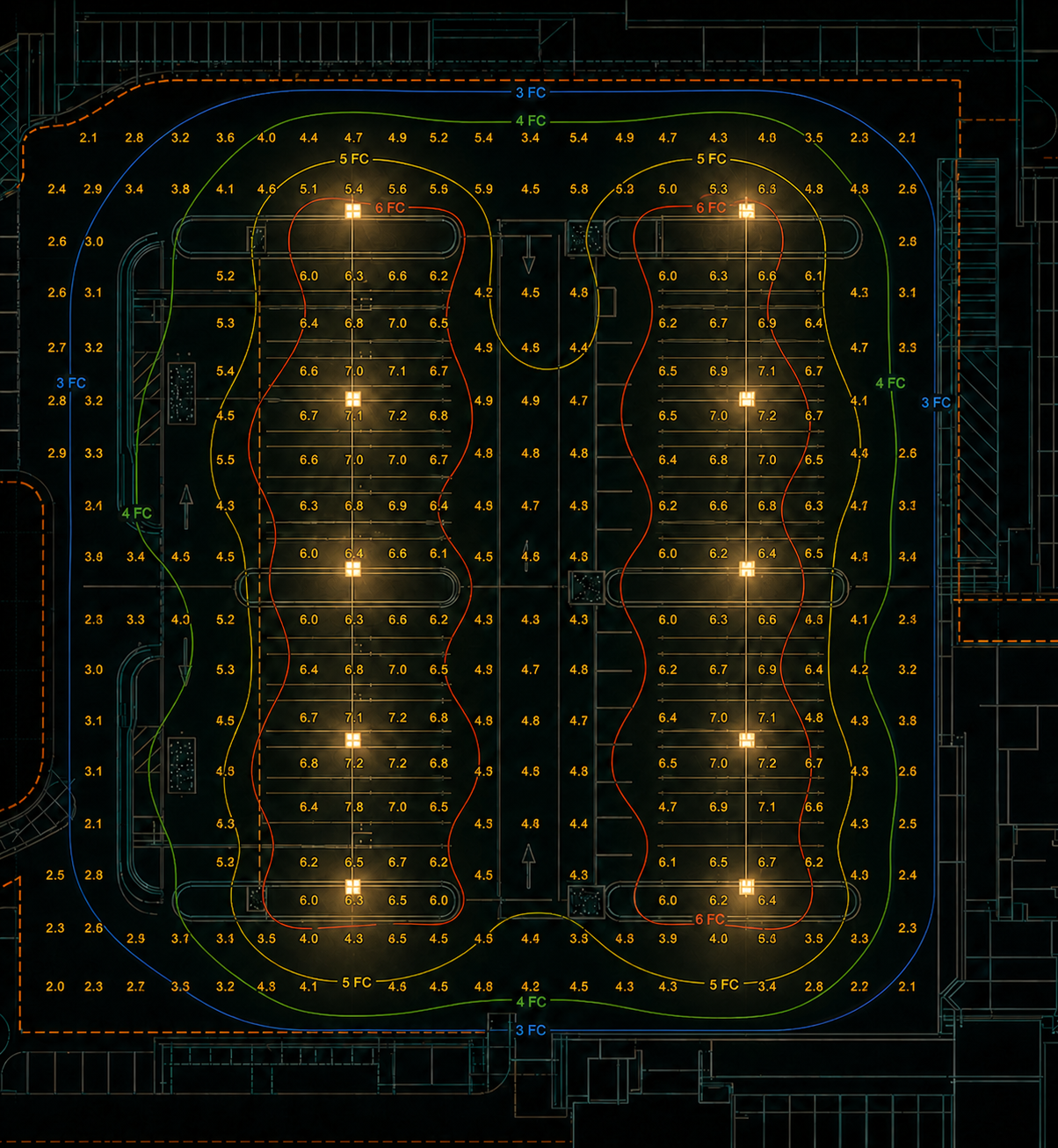
A photometric analysis is a digital simulation used to verify a lighting design’s performance before installation. This is the most important step for verifying compliance, securing permits, and eliminating design guesswork.
Using specialized software and manufacturer-provided IES files, a lighting designer models how light from each fixture will perform on the court. The simulation calculates all critical metrics—foot-candle levels, uniformity ratios, and potential glare—to confirm the design meets IES and local code requirements. To ensure your design meets all requirements, you can order a photometric plan from a provider like Stetra Lighting, which specializes in permit-ready reports.
Verifying Design Performance
The final output is a detailed photometric report that serves as primary evidence for permitting. It demonstrates due diligence and proves the design adheres to all applicable standards through color-coded renderings and precise data grids.
A photometric plan serves as the performance blueprint for the lighting system. It allows architects and engineers to optimize the fixture layout, aiming angles, and spacing on paper, ensuring the final installation performs as intended. This process identifies potential issues early, saving significant time and cost on post-installation corrections.
For more information, see this guide on photometric analysis for lighting projects.
Controls, Maintenance, and Avoiding Common Mistakes
A high-performance lighting system requires planning beyond fixture selection. Integrating intelligent controls and establishing a long-term maintenance plan are essential for maximizing energy efficiency, ensuring sustained performance, and avoiding common design pitfalls.
One of the most frequent mistakes is focusing solely on illuminance while neglecting uniformity. This results in courts with distracting hot spots and shadows that impair playability. Another common error is overlooking glare, which reduces player comfort and performance. For outdoor courts, failing to manage light trespass can lead to conflicts with neighbors and violations of local ordinances.
Best Practices for Design Success
Follow a structured process to ensure a successful outcome.
Establish the IES Class of Play First: Determine the court’s primary use—recreational (Class IV) or competitive (Class I, II, or III). This classification dictates all illuminance and uniformity targets.
Mandate a Photometric Plan: Do not estimate performance. A professional photometric analysis is non-negotiable. This simulation validates the design against performance criteria before construction begins, preventing costly rework.
Select Application-Specific Fixtures: Choose luminaires with optics and beam angles suited to the court’s specific pole heights and spacing. For indoor venues, specify a low UGR. For outdoor venues, select fixtures with an appropriate BUG rating to control spill light.
Integrate Smart Controls: Modern lighting systems benefit from controls such as dimmers, schedulers, and occupancy sensors. These features provide operational flexibility, reduce energy consumption by 30-50%, and extend the system’s operational life.
Plan for Lumen Depreciation: All LED sources experience lumen depreciation over time, defined by their L70 lifetime rating. The initial design must account for this gradual light loss to ensure the court remains compliant with minimum foot-candle requirements for years. A proactive maintenance schedule, including regular cleaning and periodic light level audits, will ensure the system performs as designed throughout its entire lifecycle.