How to Develop a Recessed Lighting Layout

A professional recessed lighting layout is based on performance targets, not simplified spacing rules. Before placing fixtures, the objective is to define clear requirements for illuminance, uniformity, and visual comfort. This ensures the final layout delivers the visibility and efficiency a project demands.

Defining Core Lighting Principles for a Layout

recessed lighting layout calculator lighting principles

A successful lighting design begins with measurable goals. This initial step guides every subsequent decision, from luminaire selection to spacing calculations. It moves beyond guesswork to establish a technical basis for the design.

Establishing Illuminance Targets

The required quantity of light, measured in foot-candles (fc), depends on the function of the space. Recommended illuminance levels are established by the Illuminating Engineering Society (IES).

  • Commercial Offices: General open-plan areas require 30–50 fc at the primary work plane. Task areas may require higher levels.

  • Retail Environments: Ambient lighting is typically designed for 50 fc. Accent lighting for merchandise displays can exceed 100 fc.

  • Industrial Spaces: Warehouse aisles may only require 20–30 fc, while detailed assembly areas need 50–100 fc for safety and precision.

Key Lighting Quality Metrics

Light quality is as critical as quantity for visual performance and comfort. Three metrics guide a professional lighting layout.

Uniformity prevents dark spots and harsh shadows. It is calculated as the ratio of the minimum light level to the average light level. A ratio of 0.6 to 0.7 is common for general illumination, ensuring even light distribution and reduced eye strain.

Glare control is measured using the Unified Glare Rating (UGR). Low UGR is essential in offices and educational facilities to prevent visual discomfort.

The Color Rendering Index (CRI) indicates how accurately a light source reveals the true colors of objects. Applications where color fidelity is critical require a CRI of 90+. These concepts are foundational, as detailed in our complete lighting plan guide.

Selecting Fixtures and Interpreting Photometric Data

recessed lighting layout calculator fixture selection

Luminaire selection directly influences spacing options and the final quality of light. A fixture’s performance characteristics are detailed in its photometric data, which is essential input for any accurate recessed lighting layout calculator. Key metrics include lumen output, beam angle, and optical efficiency. High lumen output is ineffective if the light distribution is inappropriate for the space.

Understanding Light Distribution with IES Files

Reputable manufacturers provide an IES file for each fixture. This standardized file format contains a digital map of the luminaire’s light distribution, enabling precise calculations for illuminance and uniformity in lighting software.

The beam angle is a critical parameter within the IES file. A narrow beam angle is suitable for accent lighting, while a wide beam angle provides broad, general illumination. Understanding how beam angles affect a layout is essential for proper fixture selection. Our downlight beam angle guide provides further detail.

Key Fixture Specifications for Layouts

Beyond photometric data, several practical specifications shape the final design.

  • Aperture Size: Smaller apertures offer a clean, modern aesthetic. Larger apertures can provide broader light distribution and simplify installation.

  • Color Temperature (CCT): Measured in Kelvin (K), CCT defines the perceived warmth or coolness of the light. A warm 2700K is suitable for hospitality settings, while a neutral 4000K is standard for offices and commercial spaces.

  • Unified Glare Rating (UGR): For commercial interiors, selecting fixtures with a low UGR (typically under 19) is critical for occupant comfort and productivity.

Calculating Spacing and Ratios

A professional recessed lighting layout relies on precise calculations to achieve uniform and effective illumination. Incorrect calculations can lead to wasted energy, poor visual environments, and code compliance failures.

The Spacing Criterion Ratio

The Spacing Criterion (SC), also known as the Spacing-to-Mounting-Height ratio, is found in a fixture’s IES photometric file. It is the key to preventing uneven coverage.

This ratio defines the maximum allowable distance between fixtures relative to their mounting height above the work plane. For example, a downlight with an SC of 1.2 mounted 8 feet above a work surface can be spaced up to 9.6 feet from the next fixture (8 ft x 1.2). Exceeding this distance will result in noticeable dips in illuminance. Adherence to the SC is mandatory for achieving uniform lighting.

Foundational Placement Rules

A common starting point is to place the first row of lights at a distance from the wall equal to half the calculated fixture spacing. This practice helps illuminate the room’s perimeter, creating a balanced feel.

Certain techniques, such as wall washing, intentionally deviate from this rule by placing fixtures closer to a vertical surface to graze it with light. This is effective for highlighting textures or architectural features. These principles transform theoretical calculations into a practical, buildable plan.

Adjusting Layouts for Real-World Conditions

A man adjusts a recessed light on a sloped white ceiling in a bright living room with green walls.

A recessed lighting layout calculator provides a theoretical starting grid. However, real-world spaces contain architectural obstructions and varied surface finishes. A professional layout must adapt to these variables.

Light Loss Factors and Surface Finishes

Light Loss Factors (LLF) account for the gradual reduction in light output over time due to factors like dust accumulation and lamp lumen depreciation. Including an LLF in calculations ensures the space will meet target foot-candles years after installation, not just on day one.

The room’s surface finishes also significantly impact the final lighting result.

  • High Reflectance: Light-colored surfaces with a reflectance over 70% act as secondary light sources, improving uniformity and potentially allowing for wider fixture spacing.

  • Low Reflectance: Dark wood, brick, or paint will absorb light. In these spaces, tighter fixture spacing or higher lumen packages may be necessary to achieve target illuminance.

Accommodating Architectural Features

A standard grid rarely aligns perfectly with a real-world floor plan. Beams, soffits, and skylights can create shadows if the layout is not adapted. Sloped ceilings require adjustable gimbal fixtures to direct light appropriately. The layout must work with the architecture, not against it. A calculation that ignores these variables is incomplete. The output from a basic calculator should be considered a draft, requiring professional refinement.

Ensuring Lighting Plan Compliance

A recessed lighting layout must meet strict regulatory requirements. In the United States, designs are evaluated against energy codes like ASHRAE 90.1 and California’s Title 24, which set limits on energy consumption.

Lighting Power Density (LPD) is a key measure for energy compliance, expressed in watts per square foot. For example, if the maximum allowed LPD for an office space is 0.9 watts per square foot, the design’s LPD must be at or below this threshold to comply with standards.

Performance and Environmental Compliance

Compliance extends beyond energy efficiency to include light quality and environmental impact.

  • Unified Glare Rating (UGR): Indoor spaces where visual tasks are performed, such as offices, must adhere to strict UGR limits, typically <19, to ensure occupant comfort.

  • BUG Rating: For exterior fixtures, the Backlight, Uplight, and Glare (BUG) rating is essential for controlling light trespass and pollution. Our guide to dark sky compliant lighting explains this in more detail.

Verifying Compliance with Photometric Plans

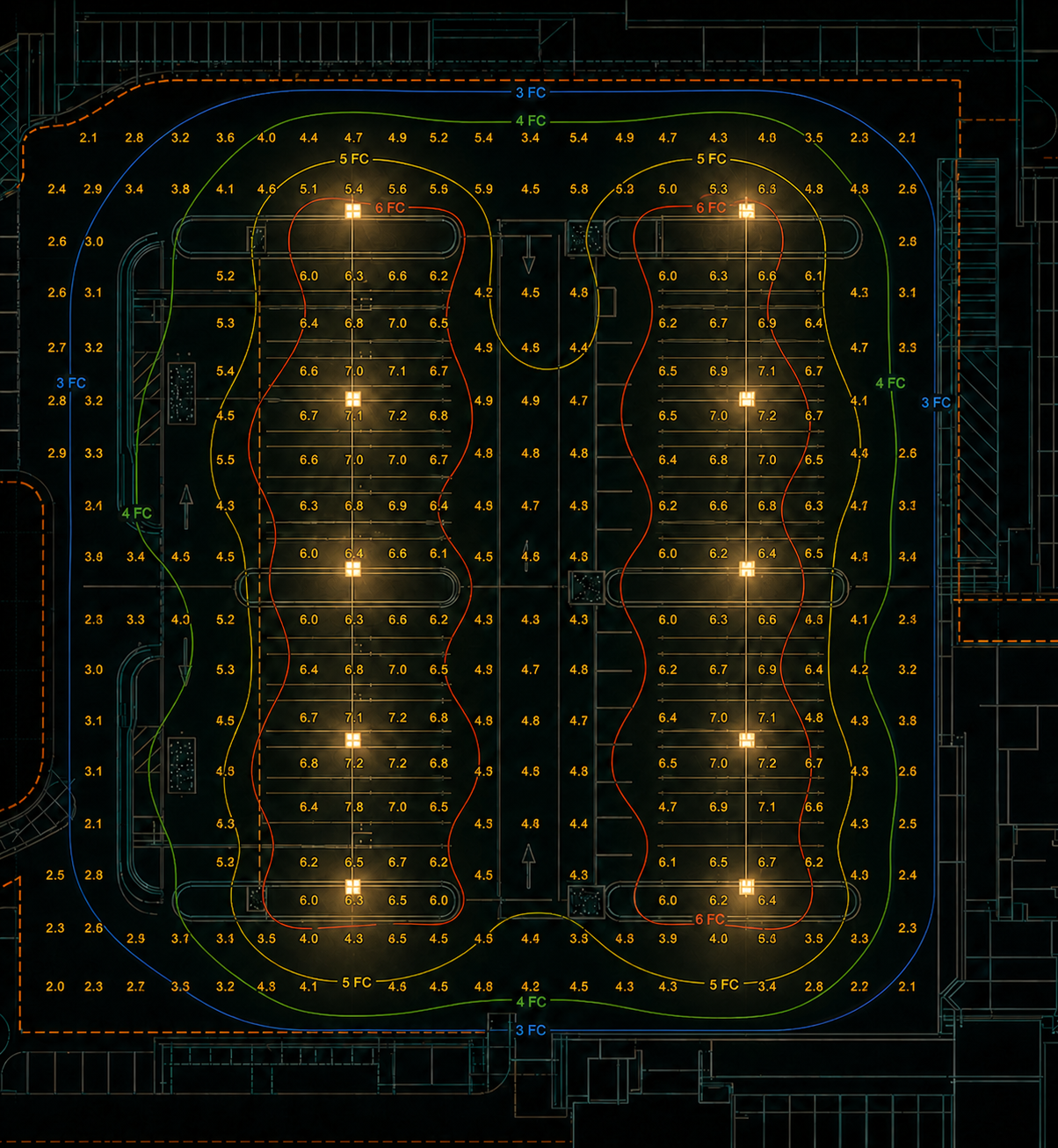
For projects requiring permits and inspections, a professional photometric analysis is the only method to guarantee compliance with all applicable codes. A certified photometric plan validates the design’s performance against LPD, illuminance, uniformity, and glare requirements.

Stetra Lighting offers certified photometric plans by employing software such as DIALux to simulate lighting performance. For projects requiring approval, you can order a permit-ready photometric plan to confirm that your design meets compliance and construction standards. This service helps eliminate uncertainty and risk during the approval process. Additionally, you can use our recessed lighting calculator for more precise planning.

Leave a Comment

Your email address will not be published. Required fields are marked *